简报
(第六期)
RESIL FARM 项目组
2026年8月6日
RESIL FARM 项目第六次项目讨论会顺利召开
孙战利研究员作专题报告并参加交流
2026年8月6日,RESIL FARM 项目骨干、中国科学院地理科学与资源研究所史文娇研究员与德国莱布尼茨转型经济农业发展研究所 ( Leibniz Institute of Agricultural Development in Transition Economies,IAMO)高级研究员、中国研究组负责人孙战利博士开展学术交流。双方围绕 RESIL FARM 项目进展、高标准农田建设对稳产固碳和气候韧性的影响、复杂农业系统时空模拟,以及土地系统演化中的反馈、阈值与状态跃迁等问题进行了深入讨论。
本次研讨以复杂系统视角下的土地系统演化及其与项目研究的结合为主线。针对 RESIL FARM 项目关注的农田稳产、固碳与气候韧性协同问题,双方重点讨论了如何从土地系统内部反馈和非线性变化出发,理解农业基础设施建设、田间管理和外部气候冲击的共同作用;以及如何衔接田间调查、遥感监测、过程模型和政策情景分析,形成从地块效应识别到区域系统演化的研究链条。
史文娇研究员介绍了 RESIL FARM 项目的总体进展及中国科学院地理科学与资源研究所承担的研究任务,即灌排条件、基础设施和田间管理对粮食产能与抗灾能力的影响。史文娇研究员还介绍了团队在农业土地系统监测与优化方面的研究进展。团队利用多源遥感、农情调查和统计资料,精细识别作物种植格局与农业资源要素,分析气候变化、灌溉条件和田间管理对粮食生产及其空间差异的影响;同时,在水土资源和生态环境约束下,模拟不同发展情景中的粮食产能、农业耗水、氮投入与碳效应,并开展多目标权衡和空间布局优化,为高标准农田分区建设、农业基础设施投入和区域种植结构调整提供依据。
孙战利研究员介绍了 IAMO 在农业与农村发展、气候变化、生态系统服务和土地系统变化等领域的研究,以及空间计量经济学、主体模型、系统动力学和贝叶斯网络等方法的应用。他指出,土地系统是人类活动与自然过程深度耦合形成的社会—生态复杂系统,通常具有反馈作用、韧性、临界阈值、状态跃迁、路径依赖和滞后效应等特征,单纯依靠线性或还原式方法难以解释系统结构和功能的持续变化。报告结合中国森林转型、阿根廷查科地区及东南亚土地利用转型等案例,分析社会经济发展、政策调控、农业扩张和自然生态过程如何共同推动土地系统变化,并展示了系统动力学因果回路和多尺度主体模型在过程表达与情景模拟中的作用。报告还强调,对人地关系的认识会影响研究范式和治理措施,土地治理需要尊重自然过程和地方条件,并针对系统变化的核心驱动因素设计政策。
围绕双方正在开展的工作,研讨重点讨论了两个方面的问题。一是将高标准农田建设视为土地系统中的重要干预,除识别平均增产和抗灾效果外,还需关注长期反馈、临界阈值及极端气候冲击下系统状态是否发生变化。二是将高分辨率遥感数据、田间调查和工程建设信息与系统动力学、主体模型及空间分析相结合,刻画基础设施、农户行为、资源约束与政策之间的相互作用,并开展跨尺度情景模拟。
本次交流表明,RESIL FARM 项目的高标准农田评价与复杂农业系统研究,可与 IAMO 的土地系统科学和复杂系统建模形成互补。后续可围绕中国及其他转型经济地区的典型案例,加强多源数据和模型方法共享,比较不同政策与气候情景下农田系统的长期演化和韧性变化,并通过联合研究、论文和中英文政策简报,为农业基础设施优化和可持续土地治理提供科学支撑。
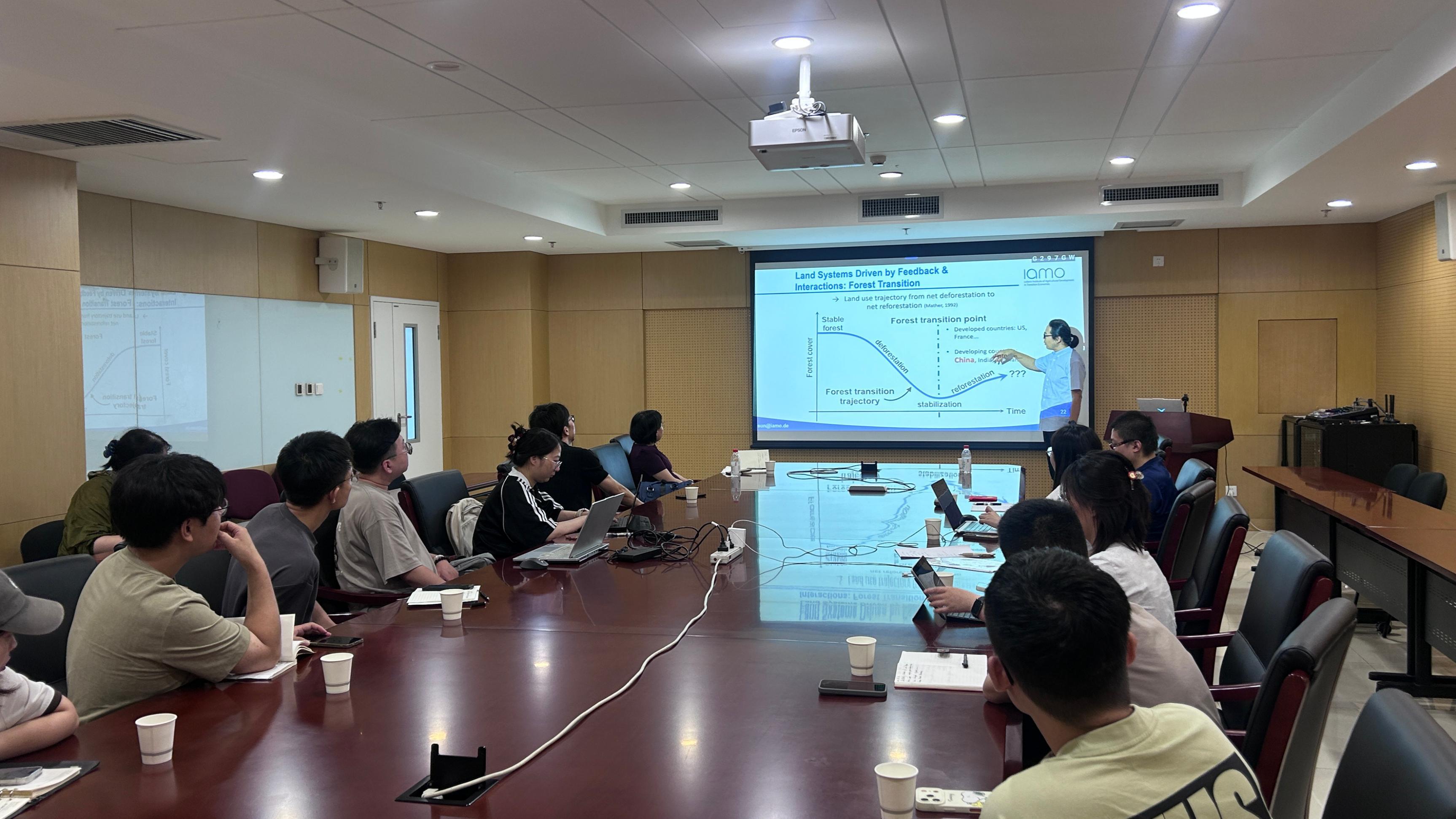
图:孙战利研究员作专题报告并与参会人员交流
Briefing (Issue No. 6)
The Sixth RESIL FARM Project Discussion Meeting
Senior Research Fellow Zhanli Sun and Colleagues Participated in the Discussion in Person
On August 6, 2026, Wenjiao Shi, the core member of the RESIL FARM project and a research professor at the Institute of Geographic Sciences and Natural Resources Research, Chinese Academy of Sciences (IGSNRR, CAS), held an academic exchange with Zhanli Sun, Senior Researcher and Coordinator of the China Research Group at the Leibniz Institute of Agricultural Development in Transition Economies (IAMO), Germany. The discussion focused on progress under RESIL FARM; the effects of well-facilitated farmland construction on stable crop production, carbon sequestration, and climate resilience; spatiotemporal modelling of complex agricultural systems; and feedbacks, thresholds, and regime shifts in the evolution of land systems.
The workshop examined how complex-system perspectives on land-system evolution can inform the project. For RESIL FARM's research on the coordinated improvement of yield stability, carbon sequestration, and climate resilience, the two researchers discussed how internal feedbacks and nonlinear change within land systems can help explain the combined effects of agricultural infrastructure, field management, and external climate shocks. They also considered how field surveys, remote-sensing observations, process models, and policy-scenario analysis could be linked to form a research chain extending from plot-level effect identification to regional land-system evolution.
Professor Shi presented the overall progress of RESIL FARM and the research task undertaken by IGSNRR, CAS, namely, examining how irrigation and drainage, infrastructure, and field management affect grain production capacity and resilience to disasters. She also outlined the team's progress in monitoring and optimizing agricultural land systems. Using multi-source remote sensing, agricultural surveys, and statistical data, the team identifies crop distribution patterns and agricultural resource elements at fine spatial scales and analyzes how climate change, irrigation conditions, and field management affect grain production and its spatial variation. Under water, land, and ecological constraints, the team also simulates grain production capacity, agricultural water use, nitrogen inputs, and carbon effects under different development scenarios, and conducts multi-objective trade-off analysis and spatial optimization. This work provides a basis for zoning well-facilitated farmland construction, investing in agricultural infrastructure, and adjusting regional cropping patterns.
Sun introduced IAMO's research on agricultural and rural development, climate change, ecosystem services, and land-system change, together with applications of spatial econometrics, agent-based modelling, system dynamics, and Bayesian networks. He described land systems as coupled social-ecological complex systems whose evolution may involve feedbacks, resilience, tipping points, regime shifts, path dependence, and hysteresis. Linear or reductionist approaches alone cannot adequately explain persistent changes in system structure and function. Drawing on forest transition in China and land-use transitions in the Argentine Chaco and Southeast Asia, the presentation examined how socioeconomic development, policy interventions, agricultural expansion, and ecological processes interact to drive land-system change. Causal-loop diagrams and multi-scale agent-based models illustrated ways to represent these processes and simulate alternative scenarios. Sun also noted that views of human-nature relationships influence research paradigms and governance measures. Land governance therefore needs to respect natural processes and local conditions and address the core drivers of system change.
The discussion focused on two connections between the two sides' work. First, well-facilitated farmland construction can be treated as an important intervention in a land system. In addition to estimating average effects on crop production and disaster resistance, evaluation should consider long-term feedbacks, critical thresholds, and possible changes in system state under extreme climate shocks. Second, high-resolution remote-sensing data, field surveys, and construction-project information can be combined with system dynamics, agent-based models, and spatial analysis to represent interactions among infrastructure, farmer behavior, resource constraints, and policy, and to support cross-scale scenario simulation.
The exchange highlighted the complementarity between RESIL FARM's evaluation of well-facilitated farmland and research on complex agricultural systems, and IAMO's work on land-system science and complex-system modelling. Future work could focus on representative cases in China and other transition economies, strengthen the sharing of multi-source data and modelling methods, and compare the long-term evolution and resilience of farmland systems under different policy and climate scenarios. Joint research, papers, and bilingual policy briefs could provide scientific support for optimizing agricultural infrastructure and advancing sustainable land governance.