简报
(第五期)
RESIL FARM 项目组
2026年7月10日
RESIL FARM 项目讨论会聚焦气候风险评估与耕地优化模拟
游良志高级研究员等现场参加研讨
2026年7月8日,北京师范大学刘志锋、叶思菁副教授、国际食物政策研究所(IFPRI)游良志高级研究员来到中国农业科学院农业资源与农业区划研究所开展学术交流,并参加 RESIL FARM 项目讨论会。会议围绕气候风险评估、耕地系统优化模拟及其与项目研究任务的衔接展开深入研讨。
刘志锋作题为《气候变化影响下的城市洪水风险与多维韧性》的报告。研究从未来城市扩张、气候变化驱动的洪泛区变化及二者交互作用出发,综合 2 种发展与排放情景、5 套人口分布数据和 9 套洪泛区数据,形成 90 组集合估计,并对全球 507 座百万人口以上城市的社会、经济、制度、基础设施和生态五个韧性维度进行评估。报告据此提出,应在全球尺度持续推进减排,在城市尺度严格管控向潜在洪泛区扩张,并针对社会、经济、制度、基础设施和生态短板实施综合适应。
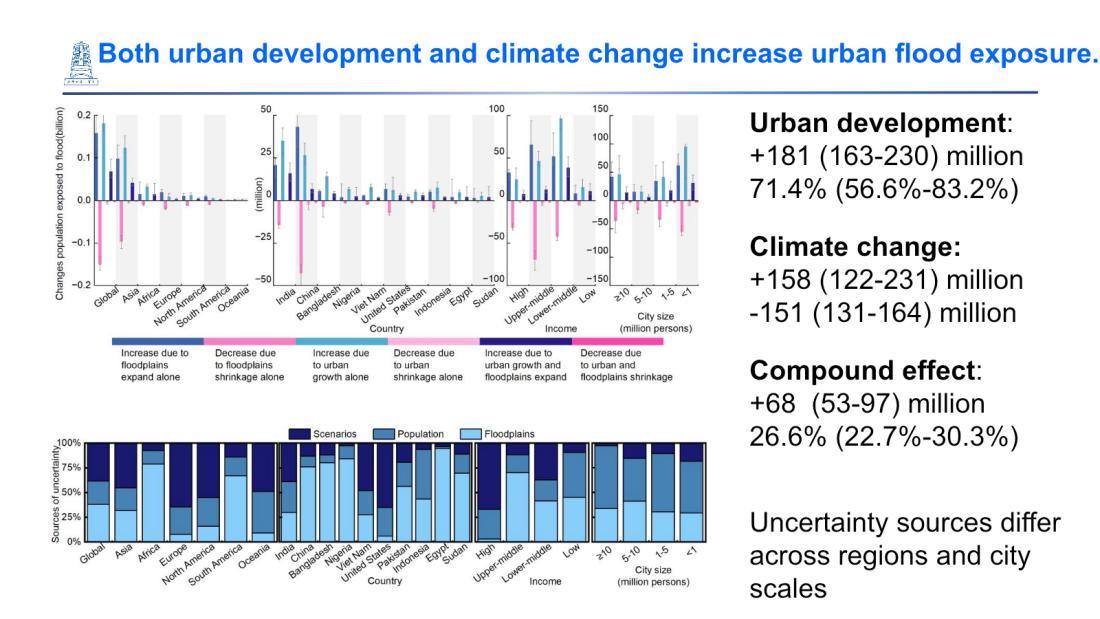
图 1 刘志锋报告展示城市发展、气候变化及其复合效应对洪水暴露的影响
叶思菁作题为《耕地优化模拟器研究》的报告。报告以全球粮食安全与行星边界的双重压力为背景,提出协同推进耕地空间布局优化与利用模式优化,通过深化“耕地利用—耕地本底—耕地功能”的级联因果认识,构建从过程诊断、机制解析到情景模拟和政策应用相衔接的耕地优化模拟器。报告强调,耕地系统中驱动因素与功能响应具有阈值效应、时空异质性、尺度效应和复杂反馈,优化方案必须因地制宜。报告重点介绍了三类研究案例:一是模拟陆表耕作条件整治对耕地产能的区域性影响。二是模拟秸秆还田量与持续时间对土壤碳储量的影响。三是协同减氮与作物布局的耕地空间优化。
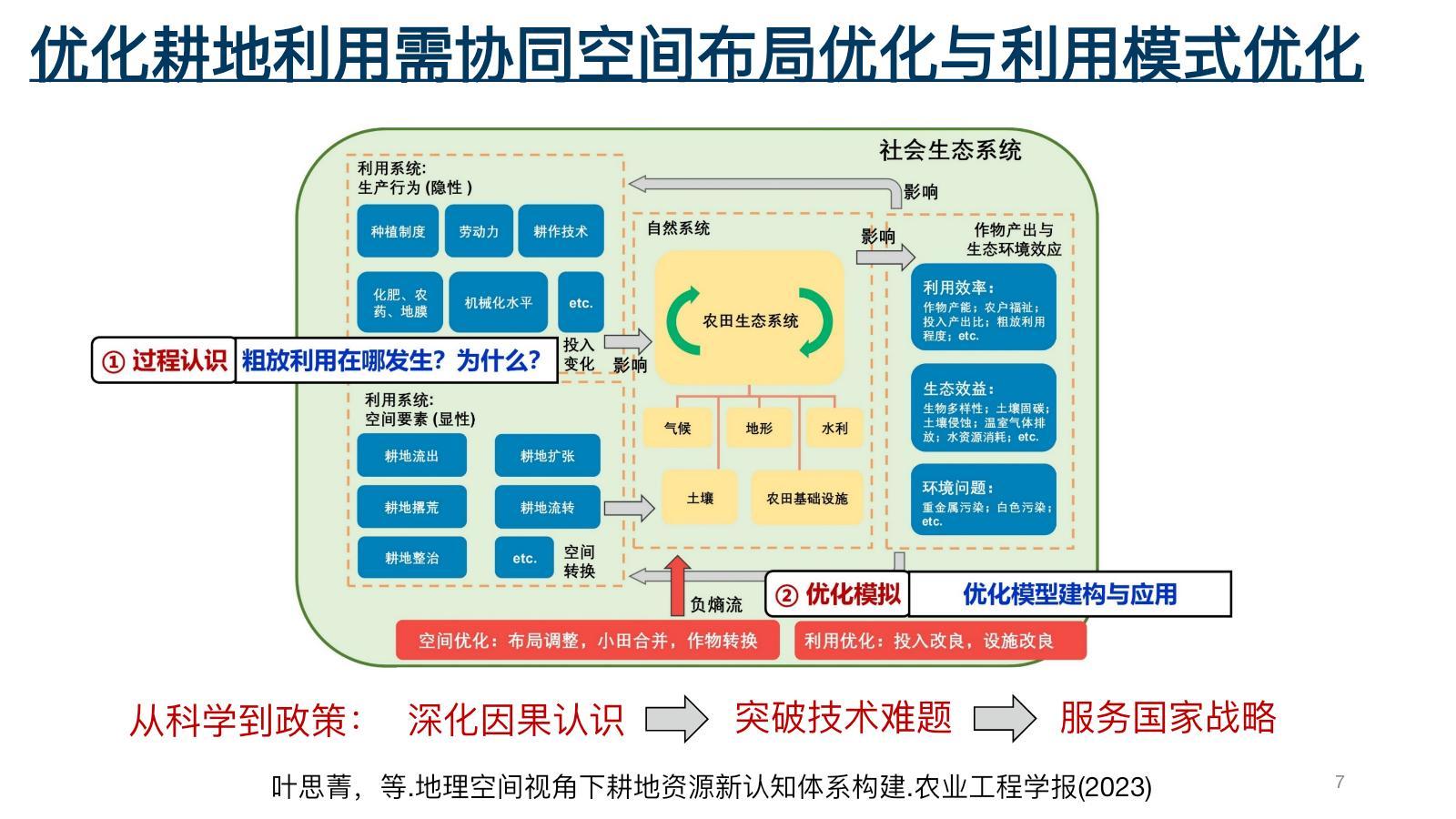
图 2 叶思菁报告展示耕地优化模拟器的总体研究框架
在交流讨论中,游良志高级研究员围绕研究问题凝练、跨尺度衔接、情景假设与不确定性、模型可解释性及政策转化等方面对两项研究进行了指导。余强毅研究员与参会人员还就成果与项目任务衔接、数据共享和模型应用进行了交流。本次会议进一步凝练了科学问题与技术路径,为推进项目合作、完善气候韧性评估与优化方法奠定了基础。
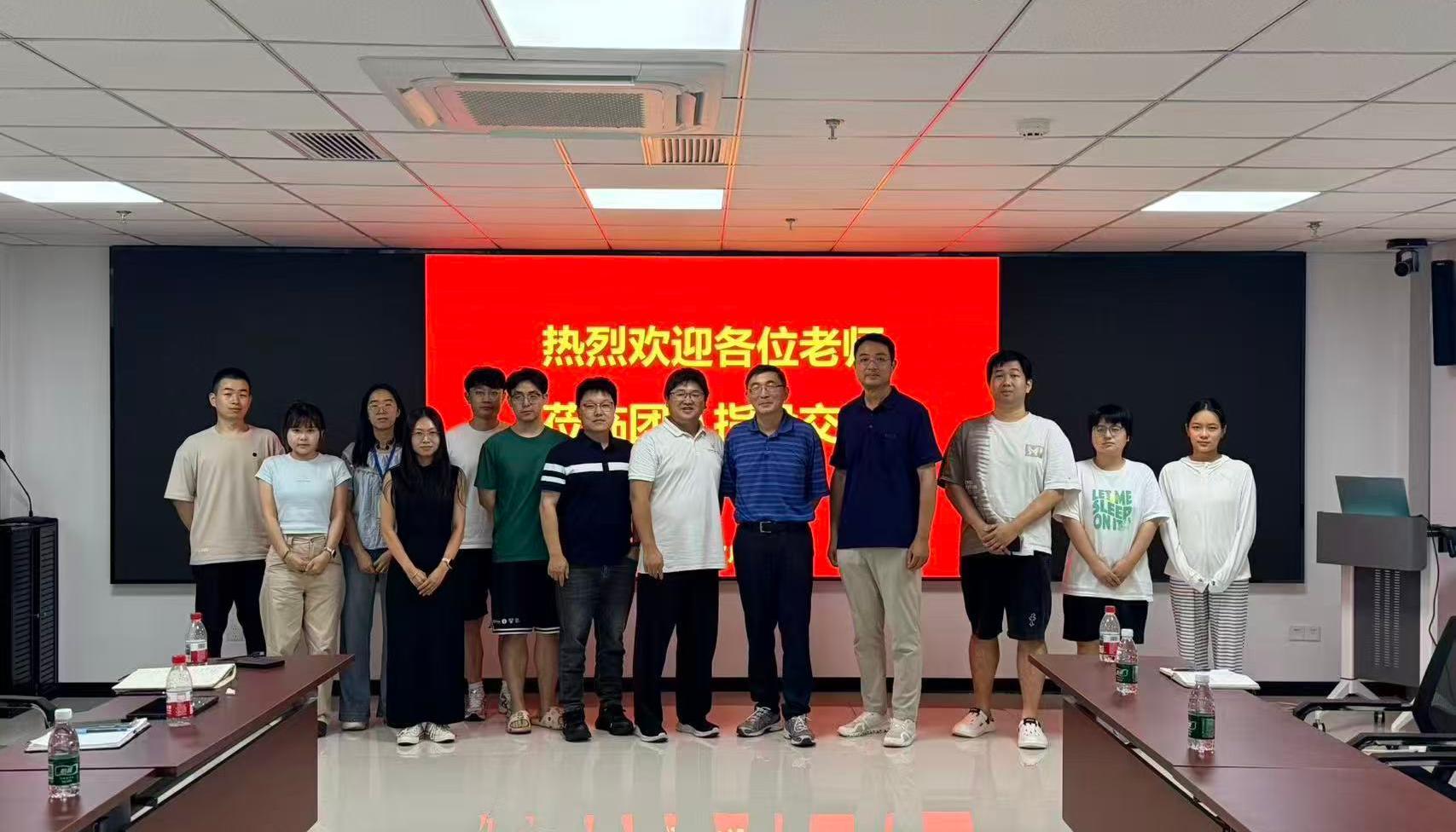
图 3 项目研讨会大合照
Briefing (Issue No. 5)
RESIL FARM Project Discussion Meeting on Climate Risk Assessment and Cropland Optimization Modelling
Senior Research Fellow Liangzhi You and Colleagues Participated in the Discussion in Person
On 8 July 2026, Professors Zhifeng Liu and Sijing Ye of Beijing Normal University, Senior Research Fellow Dr. Liangzhi You of the International Food Policy Research Institute (IFPRI) visited the Institute of Agricultural Resources and Regional Planning, Chinese Academy of Agricultural Sciences, for an academic exchange and attended the RESIL FARM project discussion meeting. Participants held in-depth discussions on climate-risk assessment, optimization modelling of cropland systems, and the alignment of these topics with the project's research tasks.
Zhifeng Liu delivered a presentation entitled "Urban Flood Risk and Multidimensional Resilience under Climate Change." The study examined future urban expansion, climate-change-driven changes in floodplains, and their interaction. By combining two development and emissions scenarios, five population-distribution datasets, and nine floodplain datasets, the researchers generated 90 ensemble estimates and assessed five dimensions of resilience—social, economic, institutional, infrastructural, and ecological—across 507 cities worldwide with populations exceeding one million. On this basis, the presentation called for sustained emissions mitigation at the global scale, strict controls on urban expansion into potential floodplains, and integrated adaptation measures targeting deficiencies in social, economic, institutional, infrastructural, and ecological resilience.
Figure 1. Zhifeng Liu's presentation illustrates the effects of urban development, climate change, and their compound effects on flood exposure.
Sijing Ye delivered a presentation entitled "Research on a Cropland Optimization Simulator." Against the dual pressures of global food security and planetary boundaries, the presentation proposed coordinating the optimization of cropland spatial configuration with the optimization of cropland-use practices. By deepening the cascading causal understanding of "cropland use–cropland resource endowment–cropland functions," the research aims to develop a cropland optimization simulator that links process diagnosis and mechanism analysis with scenario simulation and policy application. The presentation emphasized that drivers and functional responses within cropland systems exhibit threshold effects, spatiotemporal heterogeneity, scale effects, and complex feedbacks; optimization strategies must therefore be tailored to local conditions. Three research cases were highlighted: (1) simulating the regional effects of improving surface cultivation conditions on cropland production capacity; (2) simulating the effects of the quantity and duration of crop-residue incorporation on soil carbon stocks; and (3) spatially optimizing cropland through coordinated nitrogen reduction and crop allocation.
Figure 2. Sijing Ye's presentation outlines the overall research framework of the cropland optimization simulator.
During the discussion, Senior Research Fellow Liangzhi You provided guidance on both studies, with particular attention to sharpening the research questions, linking analyses across scales, scenario assumptions and uncertainty, model interpretability, and the translation of findings into policy. Research Professor Qiangyi Yu and the other participants also discussed how the research outputs could be aligned with project tasks, as well as data sharing and model applications. The meeting further refined the scientific questions and technical pathways, laying a foundation for advancing project collaboration and improving methods for climate-resilience assessment and optimization.
Figure 3. Group photograph from the project discussion meeting.